The Three Mills site in West Ham has undergone one of the most remarkable transformations of any industrial location in London, evolving from medieval flour mills to one of the capital's most significant film production centres.
The mills, located on Three Mill Lane within the London Borough of Newham, trace their origins back to the Domesday Book of 1086, when eight or nine mills were recorded on the River Lea at Stratford. The site represents the oldest recorded tidal mill system in Britain.
The House Mill: Britain's Largest Surviving Tidal Mill
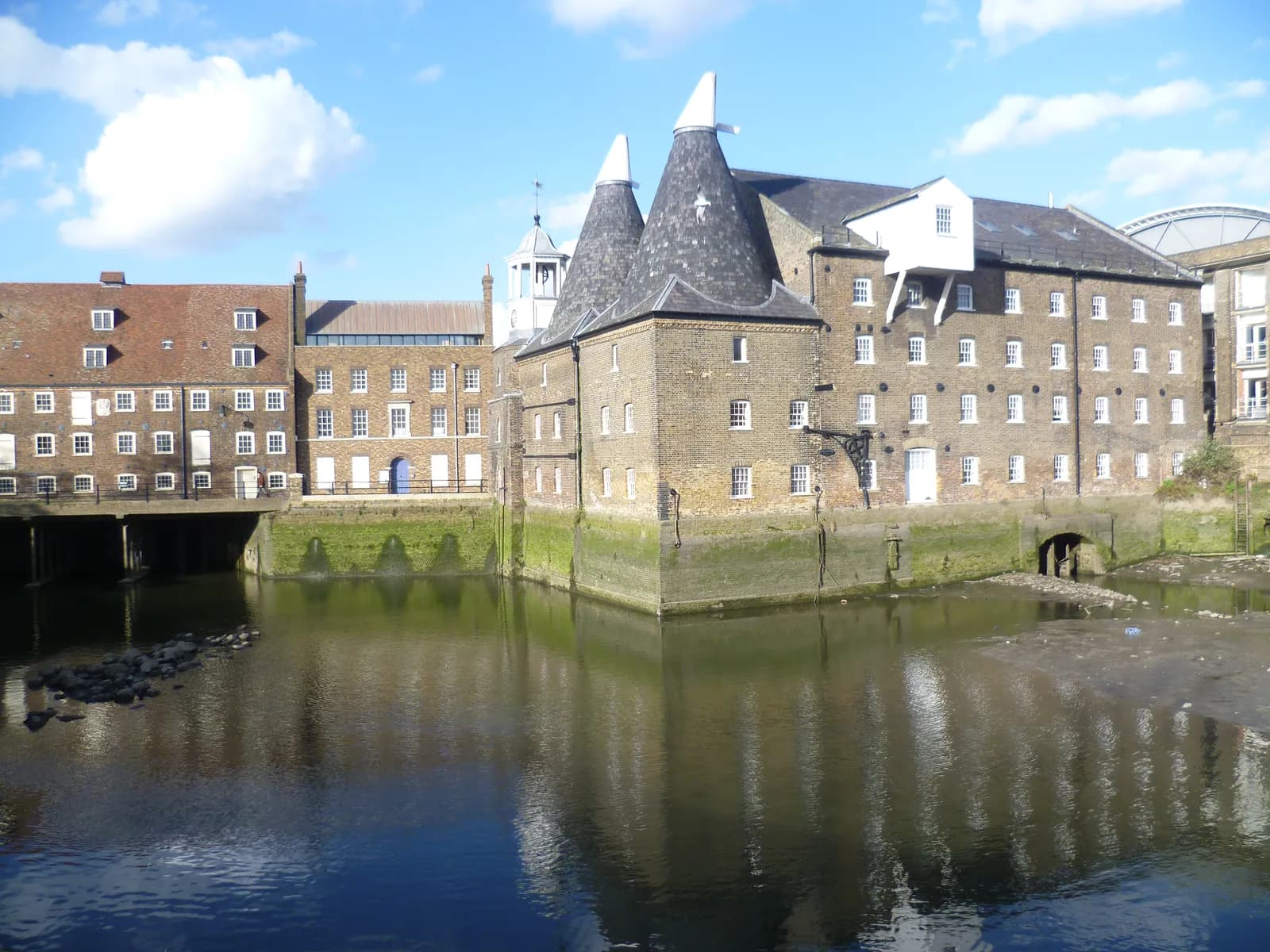
The Grade I listed House Mill stands as the centrepiece of the complex. Built in 1776 by Daniel Bisson, it is one of only four Grade I listed buildings in the London Borough of Newham. The structure, which suffered fire damage in 1802 before being rebuilt by Philip Metcalfe, features three storeys plus two additional storeys within its steeply pitched slate roof.
By 1878, the mill operated with seven waterwheels producing a combined 150 horsepower (112KW). The machinery processed an average of 125 tons of grain per week. The south facade displays a coat of arms dated 1776 with the initials "DSB", representing miller Daniel Bisson and his wife Sarah.
House Mill ceased operations in 1940, while its companion, Clock Mill, which was rebuilt between 1815 and 1817, continued until 1952.
From Grain to Gin
The industrial history of Three Mills extends beyond flour milling. Around 1730, distiller Peter Lefebure began producing gin at the site, making it a major supplier to London's gin palaces. In 1872, the distillery was purchased by J&W Nicholson & Co of Clerkenwell, which initially produced Lamplighter Gin on the premises.
The distillery operations ended in 1941, when rationing shortages forced production to cease. The Miller's House was destroyed by a bomb on 15 October 1940 during the Second World War.
The Transition to Film Production
The site's transformation began in the 1980s with the establishment of Bow Studios, Three Mills Island Studios, and Edwin Shirley Productions on the former distillery grounds. By the mid-1990s, these three operations had merged to become 3 Mills Studios, under the management of Workspace Group.
In August 2004, the London Development Agency acquired the facility. In 2010, ownership transferred to the London Legacy Development Corporation, the public body responsible for managing the legacy of the 2012 Summer Olympics.
Facilities and Productions
Today, 3 Mills Studios comprises over 75,000 square feet of filming space, including 11 filming stages and nine rehearsal rooms. Stage 7, spanning 13,483 square feet, is the largest, while Stage 5 covers 10,437 square feet, a floor area comparable to that of the Royal Albert Hall.
The studio has hosted numerous major film productions, including Wes Anderson's Isle of Dogs and Fantastic Mr Fox, Tim Burton's Frankenweenie and Corpse Bride, Legend, Topsy-Turvy, Sexy Beast, Eastern Promises, Attack the Block, Made in Dagenham, Never Let Me Go, and Lock Stock and Two Smoking Barrels.
Television productions filmed at the site include RuPaul's Drag Race UK, Giri/Haji, The Great, Luther, The Royals, Bad Girls, Jekyll and Hyde, and MasterChef, which has recorded at Three Mills since 2014.
The music industry has also made extensive use of the facility, with artists including Little Mix, Calvin Harris, Pink, Dua Lipa, One Direction, Justin Bieber, Beyoncé, Lady Gaga, and Katy Perry rehearsing or filming on the premises.
Local Significance and Access
The 2012 Olympics marked a significant moment for the site, with 3 Mills Studios housing rehearsals for the opening and closing ceremonies. The construction of Three Mills Lock for the Olympics created a head of water behind the mill, raising the possibility that the historic waterwheels could operate once again, though the lock partially removed the tidal benefits that originally powered the machinery.
House Mill is open to visitors on Sunday afternoons during summer months, while both the mill and the rebuilt Miller's House are available for weddings, meetings, and events. The Grade I listed building will mark its 250th anniversary in 2026.
Three Mills Green provides public open space on Three Mills Island, which forms part of the 50-mile Lea Valley Walk. The site sits near West Ham station, served by the Jubilee, Hammersmith and City, and District lines, plus c2c rail services and the Docklands Light Railway.
Across the water, the Sugar House Island development, a 26-acre site opposite the mills, is expected to bring 2,500 jobs to the area, adding to the economic significance of this historic industrial hub in West Ham.