For more than four centuries, a Cistercian monastery stood where West Ham meets Stratford, commanding vast estates and hosting kings. Though nothing remains above ground today, the abbey's influence shaped the local landscape, economy, and civic identity in ways that persist nearly 500 years after its dissolution.
Foundation on the Marshes
On 25 July 1135, William de Montfichet established a monastery dedicated to St Mary on marshland between the Channelsea River and what is now Manor Road. The house began as a Savigniac foundation, daughter to Savigny Abbey in Normandy, before absorption into the Cistercian Order in 1147. Situated within the ancient parish of West Ham, the monastery was also known locally as West Ham Abbey.
The location placed the community at the edge of the Thames floodplain, a position that would bring both agricultural richness and periodic devastation. The monks chose the site for its isolation and access to waterways, essential for the Cistercian way of life that emphasised self-sufficiency and manual labour.
Rise to Wealth and Power
Stratford Langthorne grew to become one of England's largest and wealthiest Cistercian houses. By 1291, the abbey's temporalities were valued at £209 3s. 3½d yearly. The 1535 Valor Ecclesiasticus recorded gross revenues of approximately £573 15s. 6¾d, making it the fifth largest Cistercian abbey in England at the dissolution.
The house controlled over 20 manors across Essex, Kent, and Berkshire, including substantial holdings at West Ham, Leyton, Great Burstead, and Chadwell St Mary. Within West Ham alone, the abbey held 1,500 acres of demesne land.
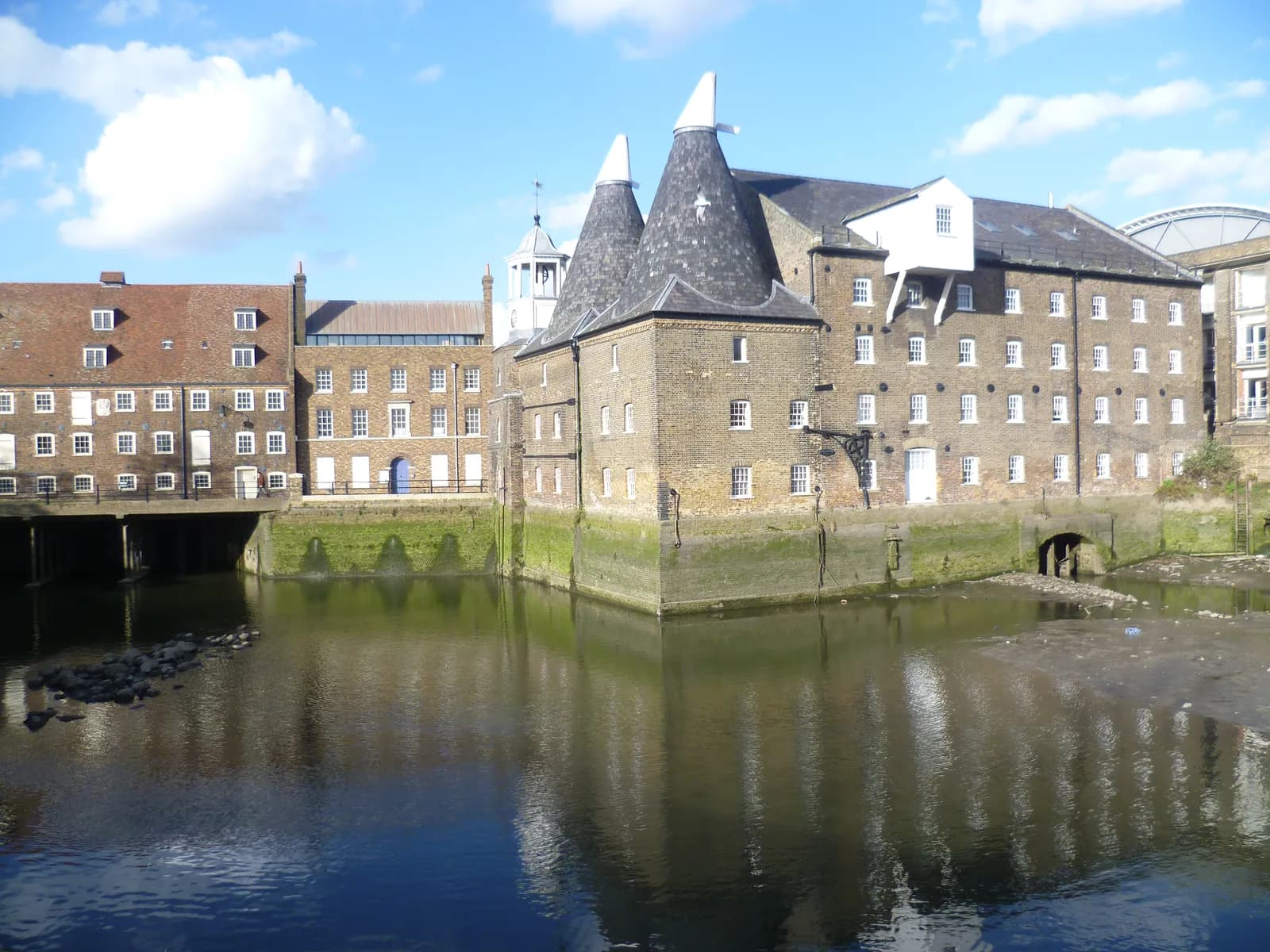
Economic activity extended beyond agriculture. The monks operated tidal mills at Three Mills and maintained workshops for brewing, shearing, weaving, and tanning. By the 15th century, a small river port had developed at Stratford to serve the abbey's commercial needs. This milling operation supplied wheat to bakers providing bread to the City of London, creating competition with the Guild of Bakers that led to toll disputes at Whitechapel.
Royal Patronage and National Events
The abbey's size and proximity to London attracted sustained royal interest. Richard I granted liberties to the convent in September 1189 and confirmed its possessions that December. Henry III granted free warren in demesne lands in 1253, along with market rights at Great Burstead and an annual fair.
In 1267, Henry III received the Papal legate at the abbey and made peace with the barons under the terms of the Dictum of Kenilworth. Henry IV visited several times in 1411 and 1412. Edward IV was entertained at the abbey in 1467 and subsequently granted the convent two tuns of wine annually for the celebration of masses; this was later commuted to a £10 annuity in 1479.
Richard II took the abbey into his protection in 1397, declaring himself its founder. This royal patronage reflected both spiritual devotion and political calculation, as control of wealthy religious houses reinforced monarchical authority.
Trials and Resilience
The abbey's history included significant setbacks. In 1336, the earl of Hereford and Essex was buried within its walls, but two years later severe Thames flooding forced the monks to decamp temporarily to their estate at Great Burstead. The late 14th century brought further flooding that damaged buildings, prompting restoration work funded by Richard II.
The Peasants' Revolt of 1381 saw the abbey invaded, its goods removed, and its charters burned. A royal commission was appointed on 7 August that year to investigate the matter.
The End of Monastic Life
The 16th century brought the abbey into close contact with the Tudor court. Abbot Robert was appointed to receive Katharine of Aragon in 1501. In September 1533, Abbot William assisted the bishop of London at the baptism of Princess Elizabeth at Greenwich. The same abbot assisted at the funeral of Queen Jane Seymour in 1537.
On 18 March 1538, Abbot William Huddlestone signed the deed of surrender, together with the chanter, sacrist, and eleven monks. The last abbot received an annual pension of £80. The monastery's wealth made it an attractive prize; Sir Peter Meautas and his wife Johanna received the lands "for their true and faithful service," whilst Sir Richard Ryche obtained the manor and rectory of Great Burstead along with other properties.
Traces in the Modern Landscape
No above-ground structure of Stratford Langthorne Abbey survives. The Great Gate stood in Baker's Row until 1825. Today, Abbey Lane and Abbey Road commemorate the site, whilst Langthorne Street (destroyed by wartime bombing and redeveloped in the 1960s) once marked the northern approach.
Archaeological investigations in 1993 and 1994, conducted before construction of the Stratford Market Depot for the Jubilee Line Extension, uncovered 647 burials from the Cistercian cemetery. These remains were reinterred at Mount St Bernard Abbey in Leicestershire.
Excavations in 2008 at Bakers Row identified the former gatehouse, located to the north-east of the abbey church. The site is now occupied by Abbey Gardens, a community garden maintained by the Friends of Abbey Gardens and protected by scheduled monument status.
Material traces survive at All Saints West Ham Parish Church, where a stone window and a carved skull (thought to have been positioned above the charnel house door) date from approximately 1180. The Old Court House on Tramway Avenue displays the abbey's coat of arms above its doorway.
The abbey's heraldic legacy continues in the London Borough of Newham's coat of arms, adopted in 1965 from the former County Borough of West Ham. The chevrons derive from the Mountfichet family arms, combined with an abbot's crozier to commemorate the Cistercian foundation. Langthorne Road and the former Langthorne Hospital in Leytonstone also recall the medieval house.
A Lasting Legacy
For four centuries, Stratford Langthorne Abbey dominated the economic and spiritual life of West Ham. Its mills ground grain, its farms fed London, and its monks provided hospitality to travellers and royalty alike. The dissolution transferred this wealth to secular hands, but the abbey's influence persisted in field boundaries, road names, and civic symbolism.
The modern London Borough of Newham encompasses the territory once governed from this single monastery. Understanding the abbey's history illuminates the deep roots of settlement, commerce, and faith that underlie one of East London's most dynamic areas.