On Friday, 19 January 1917, at six minutes to seven in the evening, the largest explosion London had ever witnessed tore through the Brunner Mond chemical works on North Woolwich Road in Silvertown, West Ham. The detonation of approximately 50 tonnes of TNT killed 73 people, injured more than 400, and damaged up to 70,000 properties across the area.
The Factory on the Thames
The Brunner Mond factory, founded in 1893 on Crescent Wharf, had originally manufactured soda crystals and caustic soda. In September 1915, following the Shell Crisis of the First World War, the government compelled the company to convert the plant to TNT purification, despite the firm's opposition. The process was significantly more dangerous than TNT manufacture itself, and the factory sat in the densely populated heart of West Ham, surrounded by terrace housing, schools, and churches.
F.A. Freeth, the chief scientist who invented the purification method, had warned that the process was "manifestly very dangerous." His concerns proved well-founded. By January 1917, approximately nine tonnes of TNT were being processed daily at the Silvertown works, much of it stored in railway goods wagons awaiting transport.
The Explosion
Fire broke out in the melt-pot room during the evening of 19 January. Among those who rushed to the scene was Andrea Angel, the plant's chief chemist, along with firemen from the nearby Silvertown Fire Station. The workers knew the risks; some local residents, recognising the danger, grabbed their children and fled immediately.
At 6.52 p.m., the fire reached the TNT stores. The explosion was catastrophic. The blast destroyed the factory instantly, along with the adjacent Venestas plywood works, Silvertown Fire Station itself, and 900 nearby houses. Six hundred houses were demolished entirely. A gas holder on the Greenwich Peninsula was damaged, releasing 200,000 cubic metres of gas that ignited into a massive fireball. Debris rained down for miles; red-hot chunks of wreckage sparked secondary fires across West Ham.
The Human Cost
The death toll of 73 was, remarkably, lower than it might have been. The explosion occurred when most factory workers had gone home, with fewer than 40 people inside the TNT plant itself. Among the dead were Andrea Angel, the firemen who had arrived to fight the initial blaze, Police Constable Edward George Brown Greenoff, and numerous Port of London Authority workers and local residents.
Four victims succumbed to their injuries in the days following the blast. More than 400 people were injured, many seriously. Thousands were left homeless, sheltered temporarily in schools and churches across the borough.
Emergency Response and Aftermath
Emergency services responded immediately, though many firemen had perished in the initial blast. The Salvation Army dispatched a rescue team led by Catherine Bramwell-Booth. The YMCA established aid stations, providing food and hot drinks to survivors and rescue workers. First-aid posts appeared in the streets of Silvertown.
The government announced the explosion the following day with measured understatement: "The Ministry of Munitions regrets to announce that an explosion occurred last evening at a munitions factory in the vicinity of London. It is feared that the explosion was attended by considerable loss of life and damage to property."
Reconstruction and Controversy
By February 1917, between 750 and 1,700 men were employed in the clear-up and reconstruction under the direction of Sir Frank Baines. An Explosion Emergency Committee had been established the day after the disaster. Yet the recovery exposed uncomfortable truths about local housing conditions.
During a parliamentary debate in July 1917, MPs Alfred Mond and Henry Cavendish-Bentinck heard that reconstructed housing remained "not fit for human habitation" and was "gravely prejudicial to the public health." Some officials suggested relocating residents to a garden city rather than spending £1.3 million rebuilding slums. The proposal was not adopted; the community rebuilt where it had stood.
The Inquiry
An official inquiry led by Sir Ernley Blackwell produced a report published on 24 February 1917. The inquiry concluded that no single definite cause could be determined, invalidating theories of German sabotage or air raid. However, the report was damning in its assessment of the site choice, describing it as inappropriate and unsuitable for TNT purification. Management and safety practices were criticised, particularly the storage of TNT in unsafe containers close to the plant.
The report was not disclosed to the public until the 1950s, preventing lessons from being learned and questions from being answered.
Recognition and Remembrance
Three men were posthumously honoured for their courage. Andrea Angel and George Wenbourne received the Edward Medal (First Class) for their attempts to control the fire. Police Constable Greenoff was awarded the King's Police Medal; his sacrifice is commemorated on the Memorial to Heroic Self-Sacrifice in Postman's Park in central London.
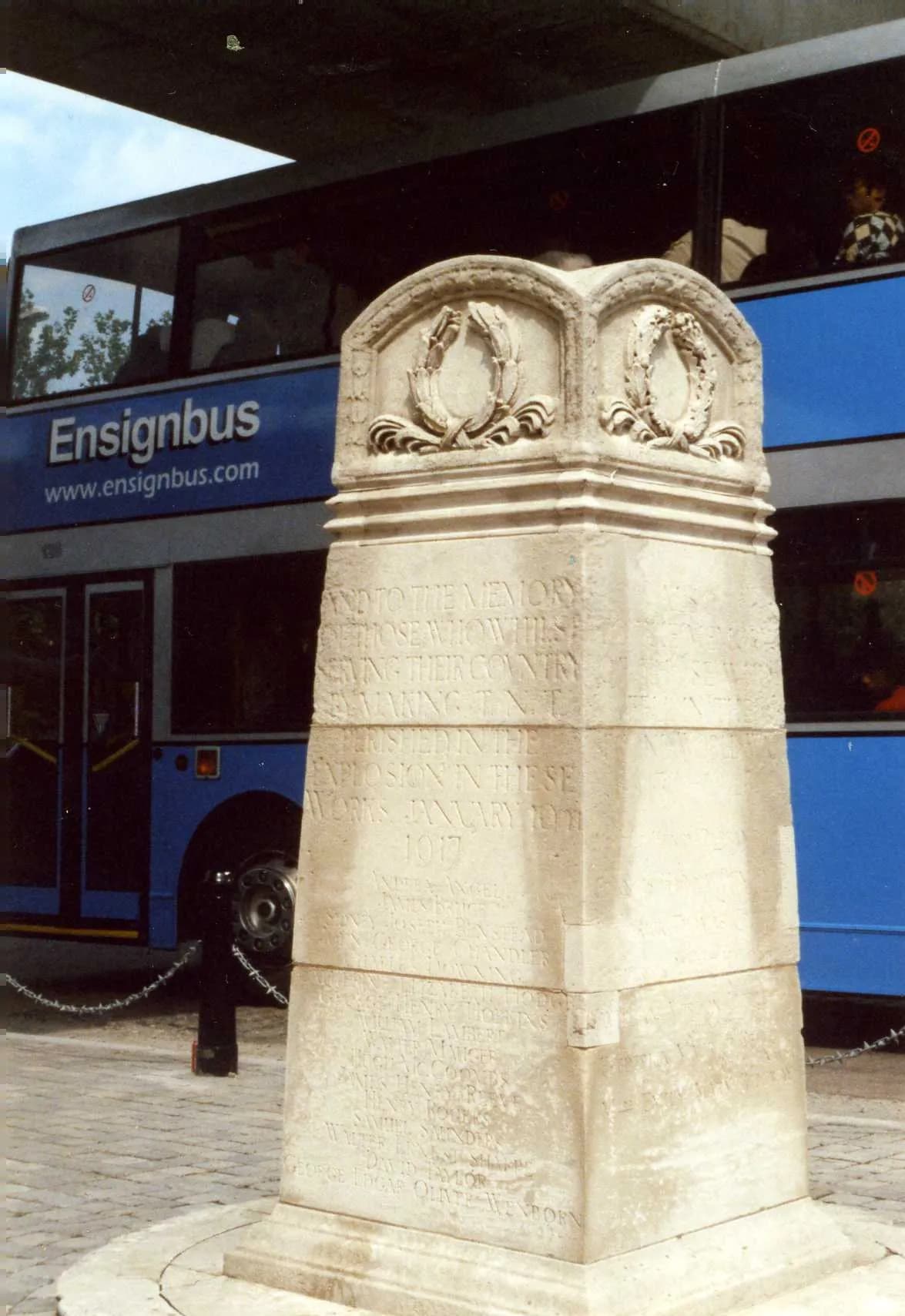
In the 1920s, Brunner Mond erected the Silvertown War Memorial on North Woolwich Road. The tapering limestone obelisk, approximately 1.5 metres high, bears the names of 18 workers who perished in the explosion, including Andrea Angel, alongside seven men who fell in the First World War and seven from the Second World War. The memorial was listed Grade II in 1999 and relocated in 2016 to a new position within the Royal Wharf development, closer to the original explosion site.
On 17 January 2017, relatives gathered to commemorate the centenary of the disaster.
The Site Today
The Brunner Mond factory site remained unbuilt for nearly a century, an empty expanse bearing silent witness to the tragedy. A neighbouring factory, which survived the blast and operated until 1961, also stood idle for decades. In 2015, a £3.5 billion redevelopment was approved, including the restoration of the iconic Millennium Mills, which had been badly damaged in the 1917 explosion.
The disaster remains the largest explosion in London's history, a grim testament to the dangers of wartime exigency overriding safety concerns, and a defining moment in the history of West Ham.