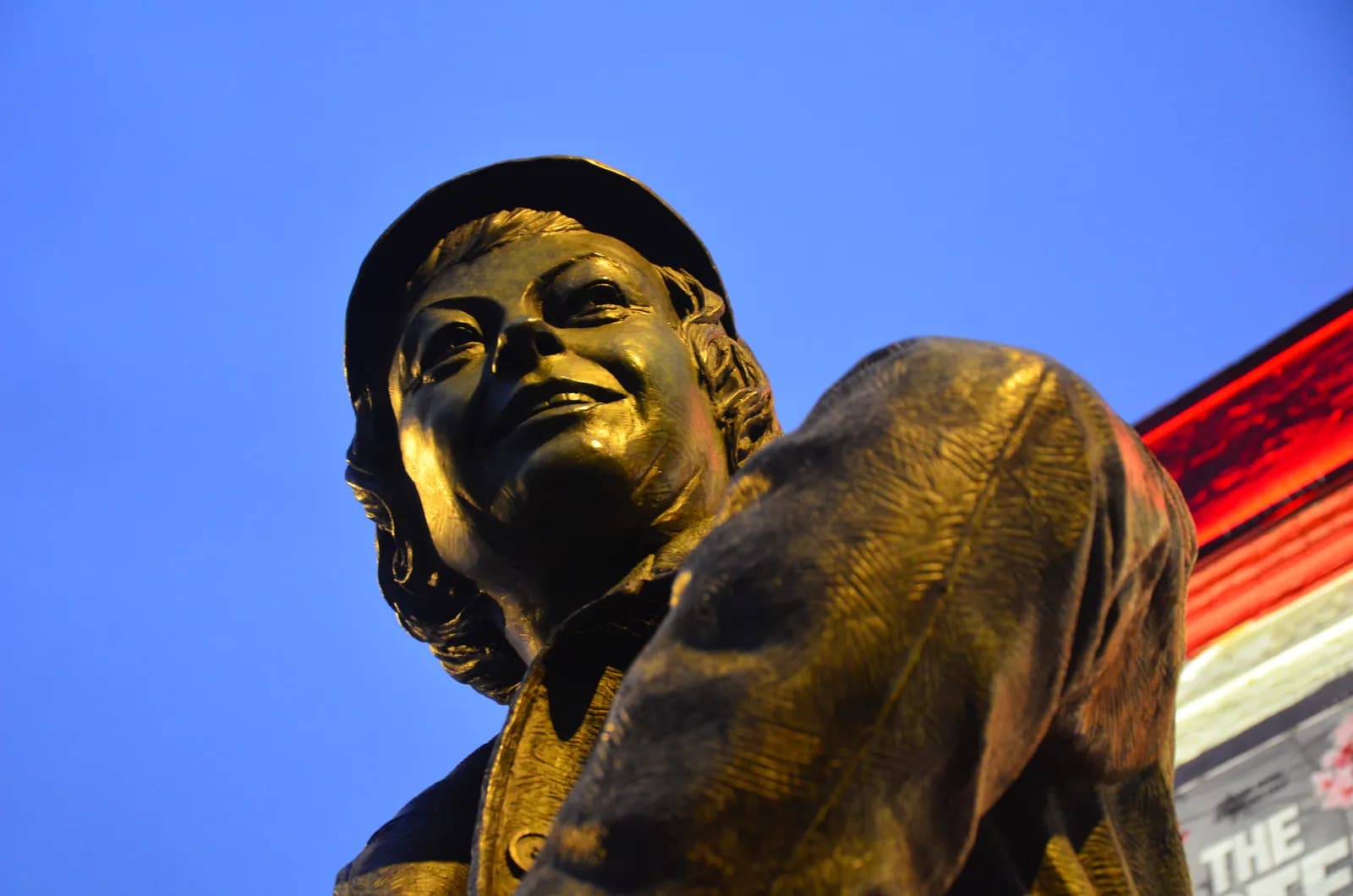
Joan Maud Littlewood arrived at the Theatre Royal Stratford East in 1953 and transformed it into a home for working-class theatre that would change British culture. For two decades, she and her company lived, worked, and created within these walls, producing plays that gave voice to the East End communities surrounding them.
Theatre Workshop Finds a Permanent Home
Theatre Workshop, the company Littlewood had formed with her husband Ewan MacColl in 1945 after eight years of touring, took up residence at the Theatre Royal on 2 February 1953. The building, which opened in 1884 on Stratford Broadway in what is now the London Borough of Newham, had fallen into disrepair. Littlewood and her actors did not merely occupy the space; they restored it with their own hands.
Company members cleaned and painted the auditorium between rehearsals, and to save money, the cast and crew slept in the dressing rooms. Littlewood herself returned to her home in Blackheath, but the actors lived communally, sharing tasks on a "chef of the week" duty roster. They functioned as a collective, united by Littlewood's belief that theatre should "both stimulate and entertain."
Breaking the Rules of British Theatre
Littlewood's methods were deliberately subversive. She rejected the rigid conventions of British acting, favouring improvisation and spontaneity over what she dismissed as "acting." This approach was technically illegal at the time; the Theatres Act 1843 required all scripts to be approved by the Lord Chamberlain, and improvisation violated this law. Littlewood was prosecuted twice and fined for allowing improvisation in performance.
Her commitment to working-class audiences and performers drew official suspicion. MI5 placed her under surveillance from 1939 through the 1950s, and the BBC banned her from broadcasting between 1941 and 1943. John Coatman, a BBC regional director, wrote in 1941 that he "could not allow people like this to have the use of the microphone," noting that Littlewood and MacColl were "concerned chiefly with programmes in which they were brought into continuous and intimate contact with large numbers of working class people."
Productions That Defined an Era
The Theatre Royal Stratford East quickly established a reputation for bold, innovative work. The company's debut production was Twelfth Night in February 1953. Later that year, performances of Volpone and Arden of Faversham at the Paris International Festival brought international recognition. The company travelled with costumes packed in suitcases and scenery carried under their arms; they were forced to beg for fares to return home.
Among the landmark productions that emerged from Stratford East were Brendan Behan's The Quare Fellow (1957) and The Hostage (1958). Shelagh Delaney's A Taste of Honey, which premiered in 1958, transferred to the West End and later became a celebrated film. The musical Fings Ain't Wot They Used T'Be (1959) ran for over two years before transferring. Stephen Lewis's Sparrers Can't Sing followed in 1960.
The company's most enduring creation was Oh, What a Lovely War! (1963), a satirical musical about the First World War devised through improvisation. It won the Award of the Grande Prix du Festival and earned Littlewood a Tony nomination. The production has been regularly revived and remains a touchstone of British political theatre.
Nurturing Working-Class Talent
Littlewood became known as "The Mother of Modern Theatre" not only for her directing but for her eye for talent. She actively sought performers from working-class backgrounds who would never have found places at conventional drama schools. Her company at Stratford East became a launching pad for actors who would achieve national fame.
Among those who began their careers under her direction were Richard Harris, Murray Melvin, Barbara Windsor, Victor Spinetti, Brian Murphy, Avis Bunnage, Harry H. Corbett, Yootha Joyce, Glynn Edwards, George A. Cooper, Stephen Lewis, Howard Goorney, and Nigel Hawthorne. The theatre critic Michael Billington later wrote that "if anything united her actors, it was their ability to communicate instantly with a live audience."
A Vision Beyond the Stage
Littlewood's ambitions extended beyond conventional theatre. In the 1960s, she conceived the Fun Palace alongside architect Cedric Price: a radical multi-arts centre that would be open to everyone, designed to adapt and change according to community needs. The building was never constructed, but its concepts influenced later projects including the Centre Pompidou in Paris. The Fun Palaces campaign continues today as an annual community-led cultural event held on the first weekend of October.
The Stratford Legacy
Littlewood left the Theatre Royal Stratford East in 1974, two years before the death of her partner Gerry Raffles. The theatre was saved from demolition in the 1970s following a public campaign and was Grade II* listed in June 1972. It has continued under successive artistic directors, including Philip Hedley (1979–2004), Kerry Michael (2004–2017), Nadia Fall (2017–2025), and from 2025, Lisa Spirling.
The theatre maintains Littlewood's commitment to "portraying and expressing the experience of local people in East London." The Open Stage Project, launched in 2012, enables local residents to participate directly in programming and productions.
On 4 October 2015, a bronze statue of Joan Littlewood by sculptor Philip Jackson was unveiled outside the Theatre Royal. The accompanying plaque notes that she "arrived at Theatre Royal Stratford East with her Theatre Workshop Company in 1953 and ran it with her partner Gerry Raffles until 1974."
Joan Littlewood died in London on 20 September 2002, aged 87. Her autobiography, Joan's Book, was published in 1994. She received the Society of London Theatre Special Award in 1983 and was named Commandeur de l'ordre des Arts et des Lettres in 1986. The theatre she transformed remains a producing house, its programme still shaped by her conviction that theatre belongs to the communities it serves.